

An Overview of Herefordshire's Geology
Herefordshire’s unique bedrock geology is almost entirely sedimentary in origin. Dominated by the Devonian and Silurian strata, it is fringed and intruded by older rocks of the Malvern Hills Complex and the igneous Bartestree Dyke, all covered with a mantle of Quaternary 'Ice Age' deposits. The variety of geological phenomena is amazing, underpinning a beautiful landscape and a range of natural environments and botanical species whose protection the Club strongly supports.
The Precambrian Malverns Complex at Gardiners Quarry in the Malvern Hills dated as 677 million years. Intrusive igneous rock which crystallised from molten magma deep in the Earth’s crust and has been pushed to the surface along a line of weakness.
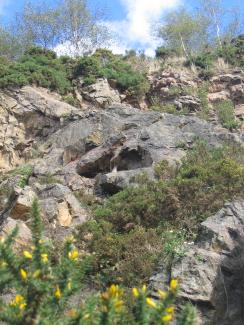
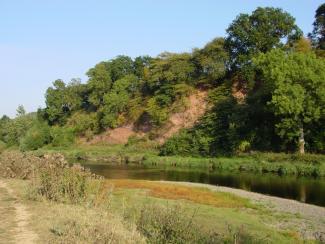
At the end of the Silurian, Iapetus Ocean closed and there was an arid land on which red mudstones with occasional green grey sandstones were deposited as seen at Red Bank Cliff by the River Wye near Hereford. These are the first of the Old Red Sandstone rocks.
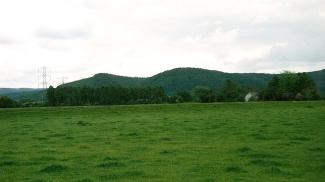
The geological activities of the Club and its members build on a remarkable heritage. Our founders had a strong interest in the emerging science of geology, and named the club for the Woolhope Dome, a remarkable geological formation in which Silurian sediments, originally laid down horizontally, were pushed up into a dome-shaped pericline by dramatic tectonic activity, eroded and exposed during quarrying. The area provide a remarkable section through these ancient strata and is the subject of a guided geological trail.
The characteristic outline of the Woolhope Dome, after which the Woolhope Club was named
Two early presidents of the Woolhope Club were pioneer geologists. Revd T. T Lewis made a huge contribution to defining the geology of the Silurian era, while Revd W. S. Symonds, a novelist and fine geologist, remains famous for his work on local Devonian fossils and excavations of Ice Age mammals at King Arthur’s Cave near Symonds’ Yat.
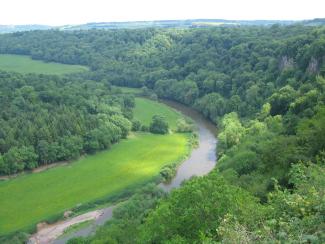
Carboniferous Limestone cliffs at Symonds' Yat, on which peregrine falcons nest. The River Wye below is incised into the landscape. The limestone contains King Arthur's Cave, excavated by the Woolhope Club in 1871 and again in 1929 to produce evidence of Ice Age mammals and prehistoric human habitation
In the winter, the Club runs geology talks addressed by high-quality speakers and usually held on Friday evenings. In the summer, we continue a programme of field meetings to explore formations and exposures of particular interest. These activities are designed to appeal both to geology specialists, and to those wanting to know more; the current programmes can be accessed here. The Club’s geological publication, Earth Matters, includes a lively mix of reports and research articles and is published annually.
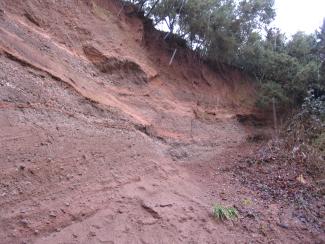
Leasows gravel pit, which is still worked occasionally, exposing a 10m section of the terminal moraine of the Hereford Formation (Late Devensian). There are deformed sand interbedded sands and silts with the deformed beds dipping at 40-90° towards 70-105°. The site shows deformation of the glacial outwash, caused when the ice made a last forward push, with lithologies including Lower Old Red sandstones, siltstones, mudstones and cornstones; Silurian siltstones, sandstones and mudstones; rare Bunter Pebbles, & coal fragments.
Today’s members participate in programmes of geological enquiry run by various organisations, for example on Ice Age Ponds, the creation of a new geological map for the Knighton area, and educational programmes with schools. Recent books published with the Club’s financial support include Herefordshire's Rocks and Scenery - a geology of the county (Ed. John Payne, Logaston Press, 2017) and Downton Gorge, the Matchless Valley (Tom and Gisele Wall, 2022), with a wide range of content including the geology.
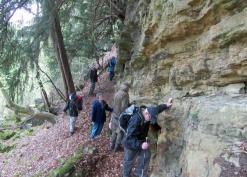
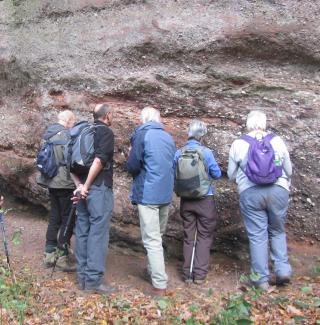
Field trip to the Upper Devonian Quartz Conglomerate of Huntsham Hill.
The Woolhope Naturalists' Field Club maintains strong links to other geological organisations, including the Herefordshire and Worcestershire Earth Heritage Trust, and the Geologists' Association.
To raise questions or make suggestions about geological topics, please email the Club at geology@woolhopeclub.org.uk
Images copyright Moira Jenkins