
IDENTIFYING POTTERY
Identifying pottery
The colour of the fabric is not a good base for identification because this depends on the firing, not the clay source, so different clay sources can appear the same if based just on colour.
Colour of pottery comes largely from the iron (Fe) present in all soils. If water is driven out of soil, oxygen is present and conditions are hot, i.e. up to 950° C, goethite (Fe 3O(OH)) a yellow from of iron in the clay changes to hematite (Fe 203) a red form of iron. At very high temperature around 1500° C the iron turns to ferrous iron Fe² which has a grey colour. A reducing atmosphere, one where oxygen in the kiln is restricted, produces the same effect, i.e. a grey colour. At 1000°C the pottery goes brown rather than red. Additions to the clay, such as chalk or chemical dyes, will change the colour, but this is rare in medieval pottery. Colour on these is given in Munsell (the international system of colour-coding) terms.
Medieval pottery consists almost entirely of cooking pots and jugs. Tiles (from the 12th century) and bricks (from the 14th) were also made and occasionally unusual forms such as lamps are found. Potsherd provides an atlas of pottery forms.
Pottery is best identified by looking at the fabric, i.e. the clay matrix of the pottery and its inclusions. See the gallery of Fabrics.
The Worcestershire Ceramics online database provides a useful resource for local pottery types.
Pottery in Herefordshire - Classification
There are various systems for classifying pottery, evolved over many years of archaeological research. The classifications used are generally those developed and used within Herefordshire and adjoining areas. Essentially this is the system developed in the 1980s by the late Alan Vince, who was for many years the leading authority on local pottery, particularly in Hereford City. His original system of several groups reflected the supposed origin of the pottery - A to D were locally or regionally produced while E was pottery from elsewhere in the British Isles, F from the European mainland and G was used for pottery the source of which was at the time unknown. Some of this has changed and the source of fabric G1 is now known to be Stafford.
With the exception of the Romano-British Severn Valley ware (A1), Group A is locally made medieval and early post-medieval pottery, much of which we now believe was made in Hereford City.
The classification is still useful to reference old pottery documentation and to help to identify new pieces. Where appropriate, other classification systems which have been used have been cross-referenced; in particular, reference is frequently made to the pottery classification used by the Worcestershire Online Ceramics Database of Worcestershire County Council
Where not otherwise attributed, the text and the photographs of the pottery were taken by Jennifer Craddock and Rebecca Roseff (RB and medieval) and David Barker (later post-medieval).
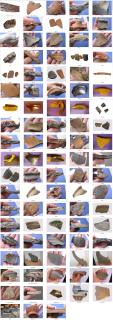
The pottery fabrics gallery below is available here in a new window which can be zoomed.
©Woolhope Naturalists' Field Club, Herefordshire