
BOTANY
Old Red Sandstone expresses more fully in Herefordshire than in any other British county, creating one of the most distinctive of English landscapes. Vegetation plays a big role in this, with much woodland clinging onto intractable slopes and generating the many satisfying long views across the intervening mixed farmland. Vein-like, rivers drain the central basin, also fringed by trees - here willows, or sallies, to use a local name still in usage.
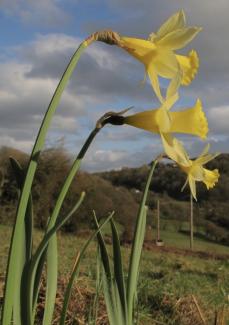
Detailed and systematic mapping allows us to understand the ways plants occupy the landscape, in the process shedding light on other things. For example Wild daffodil Narcissus pseudonarcissus is probably truly native in some parts of Herefordshire, but not in others.
Rich farmland has resulted in a county almost wholly divided up for agriculture: we lack the open downland and the unenclosed commons on infertile tertiary soils that give rise to the nature reserves, often large, of the south-east. Likewise we are mostly without the mountain ecosystems of the oceanic west. But there is no shame here. The overwhelming predominance of similar bedrocks in this borderland gives Herefordshire an ancient and natural coherence of which we can be proud. No county owes its administrative shape quite so directly to its geology.
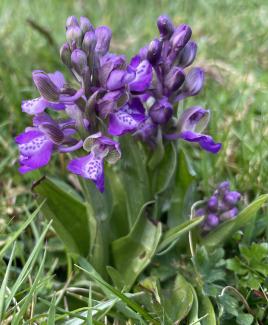
Green-winged Orchid Anacamptis morio is listed in the England Red Data book. It may be staging something of a come-back in Herefordshire. We need more eyes on the ground to understand what is happening (Brockhampton Church, April 2025).
Some old, rich grasslands and wetlands have survived intensive agriculture and indeed continue to come to light. However, the largely enclosed nature of the land means the wild plant heritage of Herefordshire has been particularly hard-hit by the use of compound fertilisers in the post-war period: it may be no coincidence then that we now have some very active voices for conservation in the county. In vegetation terms what makes us special are heavy, weakly acid meadows and pastures shot through with damp seepages, parched grasslands on outcrops of drought-prone rocks, highly-localised lime-rich flushes, extensive ash and oak woodlands, and ice-age ponds. Smaller amounts of alluvial grassland are also noteworthy. Orchards remain distinctive, though most no longer conform to the rural idyll of the imagination.
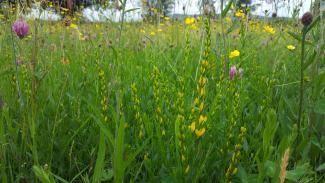
Old grassland sits at the heart of our wild plant heritage in this county. Here a tiny relict of ancient floodplain grassland at Letton Lake with Dyer’s Greenweed Genista tinctoria.
The tradition of field botany in Herefordshire continues. A few respected botanists kept the flame alive until 1950 after its illustrious debut here in the 18th century. After 1950, a run of national campaigns by the BSBI[1], each fronted by a series of ‘county recorders’ led to more systematic coverage locally and nationally, and at an increasingly fine scale. Many helped, and, in this way, continued the distinctive British tradition of nature conservation driven by amateurs. By 2010 recorders had local access and control over historic plant databases. Today there is wide scope for newcomers to the county to contribute to understanding.
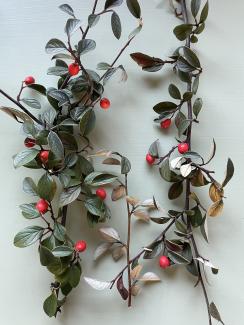
The British Flora continues to change and volunteer recording is the basis of understanding these changes. This is the garden shrub Maire’s Cotoneaster Cotoneaster mairei, now bird-sown into wild habitat (Dinmore Hill, December 2025)
First and foremost is the need for more local botanists to continue to record wild plants on their doorsteps: locals are best placed to enquire about land ownership and gain access to small woods and wetlands that are seldom visited. Several regions of the county remain stubbornly under-recorded, principally the agricultural lowlands to the north-west, north-east and south of Hereford. Then there is the need to monitor rare and declining species, and to update coverage in the light of continually evolving taxonomic understanding. Better knowledge of both garden escapes (what and where) and hybridity also mean we cannot rest on our laurels. Brambles, Rubus, are a particular shortcoming as we are told that ours is one of the most diverse areas for these plants in Britain. Further examples of topics we need to explore include the distribution of wild Lime trees, and hybridity in lime, oak, birch, Prunus species and Wild Apple Malus sylvestris. We need to sex our aspens as we have done our Black Poplars: it is conspicuous how some of our most familiar trees and shrubs are the least understood, and molecular profiling of some of these taxa is desirable. It would be great if, on top of all this, we could integrate vascular plant botany better with bryology, and get our hands dirty saving one or two species from Herefordshire extinction!
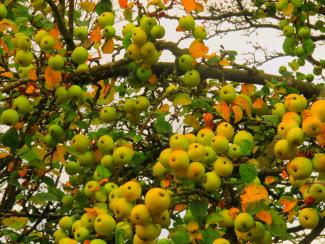
Two species which have deluded rather than eluded us are Crab Apple Malus sylvestris and Blackthorn Prunus spinosa. Both have been quietly hybridising for centuries with apple and plum, common orchard trees in Herefordshire. Molecular analysis is beginning to reveal how uncommon the respective wild progenitors are.
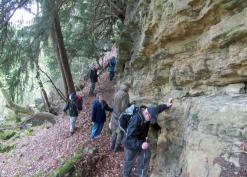
There are no natural history sub-sectional groups within the Woolhope Club, though the County Plant Recorder doubles as the club’s botany recorder, compiling an annual report within the Transactions. For those wishing to upskill, two local botanical organisations hold field meetings throughout the summer and always welcome new attendees. Contact Stuart Hedley s2arth@hotmail.com for further information.
[1] Formerly the Botanical Society of the British Isles, now the Botanical Society of Britain and Ireland.
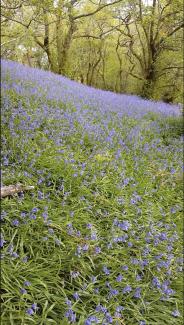
The spectacle of wild flora remains common heritage in Herefordshire, though both site protection and footpath access are relatively weak. What can we do to ensure sights like this remain common heritage? (Bluebells in the Olchon Valley).
Images copyright Stuart Headley, 2026