Gavin Heynes Jack MInstCE FRIBA FGS FSA (1874 – 1952) made his mark, not only on the Woolhope Club, but on the county itself. In 1907, after some 10 years of service in Birmingham, he was appointed as county surveyor, architect and bridgemaster to Herefordshire County Council. At the time, Herefordshire roads were in a poor state, muddy in winter and dusty in summer. Jack introduced the practice of using crude tar to seal the road surfaces, beginning the gradual improvement of the engineering of the county’s roads. He also had responsibility for bridges, and at this period these were beginning to deteriorate, the excellent work as surveyor of bridges by John Gethen of Kingsland in the late eighteenth and early nineteenth centuries having long in need of attention. Rather than go out to tender for such work, from the mid-1920s a body of men was directly employed for this work. This proved highly successful, so that in 1932 the workforce was formed into a ‘Guild of Bridgemen’.
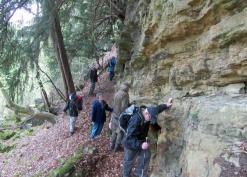
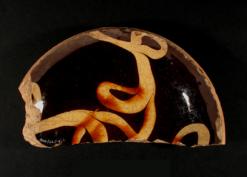
From an early age Jack was an enthusiastic geologist, and was elected a Fellow of the Geological Society at the age of 19. He joined the Woolhope Club and became editor of the Club’s geological section. In 1932 he discovered three new species of old red sandstone fossil fishes, now in the British Museum, one of which, Cephalaspis jacki (White 1935) from Wayne Herbert Quarry, is named after him.
Jack is best known, however, for his archaeological excavations at Magna Castra, the Roman town at Kenchester, just west of Hereford. The 1912-13 excavations were reported at length in the 1912 Transactions, with a supplemental report in the Transactions for 1918. A second volume detailing the excavations in 1924-5 was published in Transactions for 1924-6. Jack also conducted excavations at Caplar Camp, Brockhampton, and others that revealed the circular foundations of the Knights Templar church at Garway. His reports on these, together with numerous other papers on topics such as bridges and the career of John Gethen represented a substantial academic contribution to the Woolhope Club’s Transactions.
After his retirement, in 1933, Jack moved from Hereford, but continued to submit papers for the Transactions. He was also active in other fields, and from his retirement until 1945 acted as a consultant to the Council for the Preservation of Rural England. He died in Henley-on-Thames on 22 September 1952, and obituaries were published in Transactions as well as in the Proceedings of the Institution of Civil Engineers.
Text by John Eisel